 -->
-->

Research Activities
Here additional information is provided on our recent and current research activities. Their great majority is motivated by our recent notable research breakthroughs related into two generalization of the Design of Experiments (DoE)methodology. What is described here is related to the general areas of Data Science and Machine Learning. For a brief description of the principles guiding our research, see this page. (link to page on "Guiding Principles" ) About ten year ago, we felt that classical area of Applied Statistics on the Design of Experiments (DoE) had to important limitations with the respect to dynamic systems of interest here. This motivated us to postulate two generalizations.
- The Design of Dynamic Experiments (DoDE) methodology enables the design of experiments in which some of the factors (input variables) are functions of time. For example, experiments in which the pH and/or temperature of a cell culture is changing over time in a prespecified manner. Though the idea is simple, we consider this a substantial research breakthrough. Details in this methodology are given here. (link to "DoDE Methodology" page)
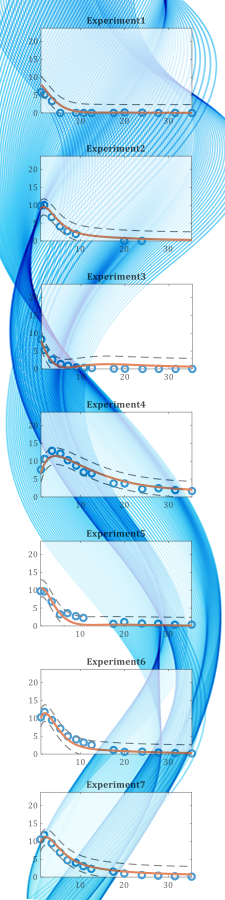
- The second major breakthrough generalizes the Response Surface Methodology (RSM) used to model the results of a set of experiment into the Dynamic Response Surface Methodology (DRSM). DRSM is used to model the time evolution of the process utilizing time-resolved output data. Details in this methodology are given here. (link to "DRSM Methodology" page)
These new methodologies have been used to provide accurate data-driven models for both batch and continuous processes in the chemical, pharmaceutical and biopharmaceutical industries.
One of the presently active projects aims to use Data-Driven DRSM models of the composition measurements in a reaction system, to discover the unknown reaction stoichiometry and the related reaction kinetics that represents that best fit the data. This will transforms the dynamic data-driven DRSM models to dynamic knowledge-driven models consisting of transient material and energy balances. More Information here (link to be provided).
A second project aims to combine our DRSM models with approximate material and energy balances to derive accurate hybrid models for processes. More Information here (link to be provided).
The above methodological breakthroughs have been to important applied directions:
- Estimation of Simple and Accurate Meta-Motels or Surrogate Models: It has been demonstrated that simple metamodels can accurately approximate the steady state characteristics of complex process models of continuous process. For example, simple quadratic input-output surrogate models can accurately represent input multiplicity characteristics. This can substantial facilitate complex and time-consuming calculations related to plant-wide optimization, operability studies and plant-wide control. An international collaboration presently aims to prove that this is also possible for the dynamic characteristics of a complex process.
- Non-Linear Sensitivity Methodology: The very popular Sobolev nonlinear sensitivity analysis is widely recognized as being very demanding computationally. We have demonstrated in two publications that the development of accurate metamodels can drastically reduce, by orders of magnitude, the computation load. Furthermore, it has been also demonstrated that just the nonlinear team of the estimated metamodel can answer questions about nonlinear sensitivities much more explicitly than the Sobolev approach. These conclusions have been demonstrated through the analysis of a ccccccc metabolic model and a very detailed Cho-cell model. In the latter case, the nonlinear sensitivity analysis has enabled the estimation of the model's parameters in much mode efficient manner.
- SRI Director
- Dr. Christos Georgakis
- Professor, Department of Chemical and Biological Engineering, Gordon Senior Faculty Fellow of Systems Engineering
Tufts University - Affiliated Faculty at Tufts
- Dr. Kyongbum Lee
- Associate Professor and Chair, Department of Chemical and Biological Engineering
Tufts University - Dr. Nikhil Nair
- Asistant Professor, Department of Chemical and Biological Engineering
Tufts University - Affiliated Faculty Outside Tufts
- Dr. Bhavik Bakshi
- Professor , Departmants of Chemical & Biomolecular Engineering, Ohio State University
- Dr. Dominique Bonvin
- Professor, Automatic Control Laboratory École Polytechnique Fédéral de Lausanne (EPFL) Switzerland
- Dr. B. Erik Ydstie
- Professor, Departmant of Chemical Engineering, Carnegie Mellon University, Professor of Electrical Engineering by Courtesy, CMU , and Professor II of Electrical Engineering at NUST, Trondheim, Norway
- Contact SRI
- Tufts University
- Science and Technology Center
- 4 Colby Strett, Room 273
- Medford, MA 02155
-
(617) 627-2573
(617) 627-3991 [FAX]
Christos.Georgakis@tufts.edu